The Avro Vulcan
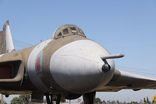
Here we shall talk a little about the RAF's greatest fast jet, the supersonic long-range bomber the Avro Vulcan. My 'office' for many years.
The Vulcan was designed as a radical response to the threat of the Soviet Union. Based on a delta-wing concept; a four-engined nuclear bomber
Several 'mini-Vulcans' were built for flight testing; these were the Avro Type 707's.
In 1952, the first prototype of what would become the Vulcan (Type 698 VX770), was ready to fly. Type 698 VX770 first flew on 30th August 1952, piloted by W.C Roly Falk, a brave man indeed.
Aircraft development in the 1950s was very primitive compared to today; no computer simulations or cockpit recording systems (no 'black box'), the instruments were filmed with cine cameras and readings later transcibed by a team of film-readers.
After several engine and aero redesigns, delivery of production B.1's began in 1956 and the first squadron (83 Squadron) formed in May 1957.
Further improvements in engine, radar and nuclear capability resulted in the B.2. Two nuclear weapons (Yellow Sun and Red Beard) could be carried. Blue Steel stand-off missiles were developed which could be fired up to 100 miles away from the target. Thank God we didn't have to fire any of that lot in anger.
With the deployment of submarine-launched Polaris ICBMs, the Royal Navy took over the RAF's nuclear deterrent role. Vulcan almost flew its entire service life without dropping a bomb in anger, except for the Falklands conflict in 1982. Damage to Argentine ground forces was limited, but politicially, pinned down a significant amount of Argentine air power to defend against British attacks on the mainland.
The final version of the Vulcan - the K.2 tanker - came into service during the Falklands war, delivered in 51 days.
In March 1984, the last Vulcan squadron was disbanded, leaving only the Vulcan Display Team to fly on. Vulcan XL426 passed into prvate hands at Southend airport, cared for by the Vulcan Restoration Trust. Vulcan XH558, became the most famous of all, flying displays until 1992; retired from the RAF she returned to the air 18th October 2007. More information: http://www.vulcantothesky.org/
The Vulcan was designed as a radical response to the threat of the Soviet Union. Based on a delta-wing concept; a four-engined nuclear bomber
Several 'mini-Vulcans' were built for flight testing; these were the Avro Type 707's.
In 1952, the first prototype of what would become the Vulcan (Type 698 VX770), was ready to fly. Type 698 VX770 first flew on 30th August 1952, piloted by W.C Roly Falk, a brave man indeed.
Aircraft development in the 1950s was very primitive compared to today; no computer simulations or cockpit recording systems (no 'black box'), the instruments were filmed with cine cameras and readings later transcibed by a team of film-readers.
After several engine and aero redesigns, delivery of production B.1's began in 1956 and the first squadron (83 Squadron) formed in May 1957.
Further improvements in engine, radar and nuclear capability resulted in the B.2. Two nuclear weapons (Yellow Sun and Red Beard) could be carried. Blue Steel stand-off missiles were developed which could be fired up to 100 miles away from the target. Thank God we didn't have to fire any of that lot in anger.
With the deployment of submarine-launched Polaris ICBMs, the Royal Navy took over the RAF's nuclear deterrent role. Vulcan almost flew its entire service life without dropping a bomb in anger, except for the Falklands conflict in 1982. Damage to Argentine ground forces was limited, but politicially, pinned down a significant amount of Argentine air power to defend against British attacks on the mainland.
The final version of the Vulcan - the K.2 tanker - came into service during the Falklands war, delivered in 51 days.
In March 1984, the last Vulcan squadron was disbanded, leaving only the Vulcan Display Team to fly on. Vulcan XL426 passed into prvate hands at Southend airport, cared for by the Vulcan Restoration Trust. Vulcan XH558, became the most famous of all, flying displays until 1992; retired from the RAF she returned to the air 18th October 2007. More information: http://www.vulcantothesky.org/
Specification
The Delta wing, the afterburners that would take you vertically up into the sky, the high-yield thermo-nuclear deterrent... great days.
The Vulcan was designed as a long-range strategic nuclear bomber. It was powered by four Rolls-Royce Olympus 201 turbojet engines that gave the aeroplane a top speed of 645 mph and a maximum ceiling of 65,000 feet. A Vulcan had a maximum range of 4,600 miles. Each bomber had the ability to carry 21,000 lbs of bombs.
In total, the RAF had 136 Vulcan bombers and its final role for the RAF before being totally withdrawn from service was as a flight-refuelling aeroplane.
It was the closest you could get to a fast-jet fighter - that's not true actually, we knocked the tail-plane off a Jaguar once, Fighter Command wasn't happy. But that's another story.
The Vulcan was designed as a long-range strategic nuclear bomber. It was powered by four Rolls-Royce Olympus 201 turbojet engines that gave the aeroplane a top speed of 645 mph and a maximum ceiling of 65,000 feet. A Vulcan had a maximum range of 4,600 miles. Each bomber had the ability to carry 21,000 lbs of bombs.
In total, the RAF had 136 Vulcan bombers and its final role for the RAF before being totally withdrawn from service was as a flight-refuelling aeroplane.
It was the closest you could get to a fast-jet fighter - that's not true actually, we knocked the tail-plane off a Jaguar once, Fighter Command wasn't happy. But that's another story.
